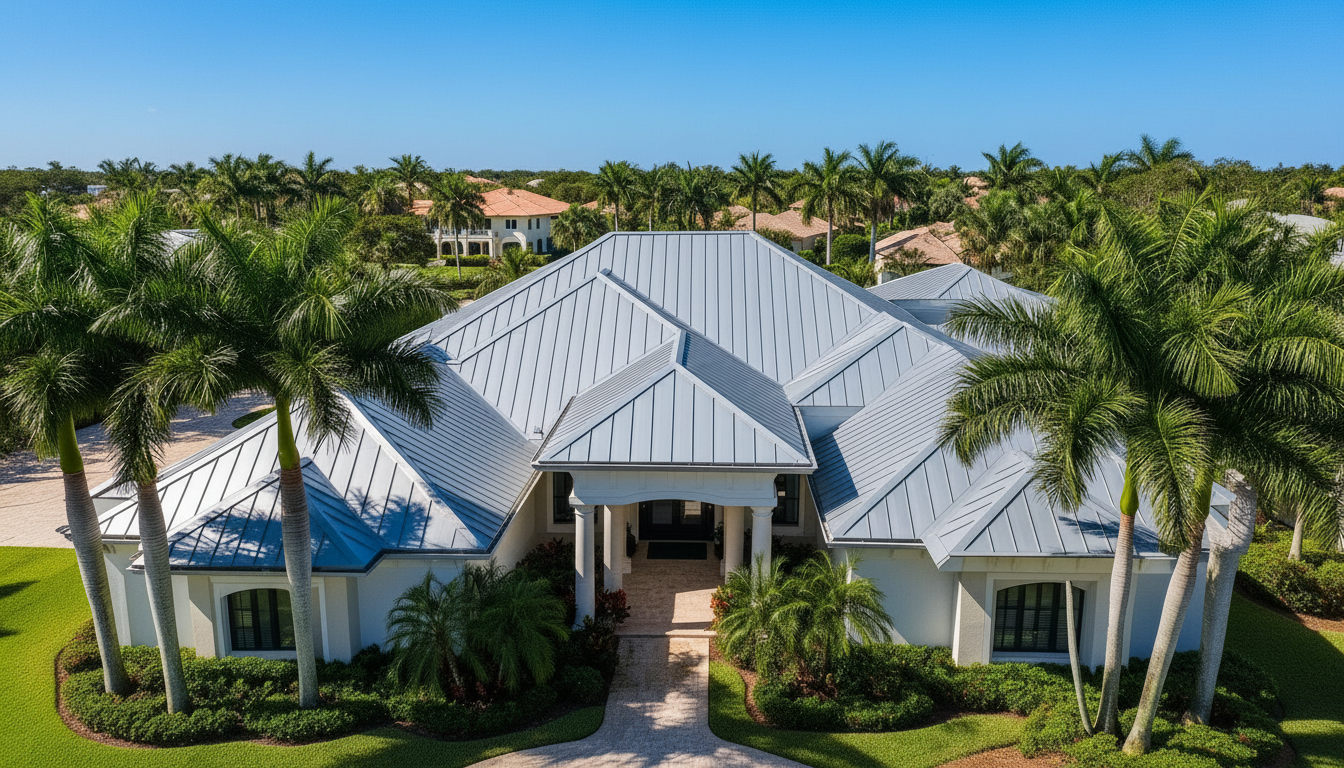
Four systems cover almost every Florida roof: asphalt shingle, metal, concrete or clay tile, and low-slope membrane. They differ in installed cost, expected service life here, structural requirements and how they behave in a wind event.
Metal Roofing
A properly installed and fastened metal roof in Florida is generally expected to outlast an asphalt shingle roof, but service life depends heavily on panel gauge, coating, fastener quality and proximity to salt air.
Sheds water fast on low-slope-to-moderate pitches, which matters during Florida downpours
Non-combustible and does not lose granules the way an aging shingle roof does
Higher material and labor cost than architectural shingle
Exposed-fastener systems need gasket/fastener inspection over time
Tile Roofing
Tile itself is durable, but a Florida tile roof is only as sound as the underlayment beneath it. Most tile roof "failures" here are underlayment failures, not tile failures — the tile can often be lifted, stacked and reset over new underlayment.
Long-lived surface material that resists UV better than asphalt
Well suited to Mediterranean, Spanish and coastal Florida architecture, and often required by HOA or deed restriction
Heavy — the structure has to be able to carry the load, which matters on re-roofs converting from shingle
Underlayment typically ages out before the tile does, driving a lift-and-relay or full replacement
Shingle Roofing
Florida sun, heat cycling and wind shorten asphalt shingle life compared with northern climates. Granule loss, cupped or curled tabs, exposed fasteners and repeated wind-lifted tabs are the practical signals that a shingle roof is nearing the end of its usable life.
Lowest installed cost of the common Florida roof systems
Fast installation, which shortens the time a home is exposed during a re-roof
Shortest service life of the common Florida systems
Wind-lifted and creased tabs are the most frequent storm-damage claim we document
Flat & Low-Slope Roofing
Low-slope roofs fail at details, not in the field: parapet terminations, scuppers and drains, curbs, pipe penetrations and the transition where a flat section ties into a sloped roof. Ponding water that does not drain within a reasonable period accelerates every one of those failures.
Single-ply membranes have few field seams once heat-welded
Reflective white membranes reduce heat load on the structure below
Ponding water is the number one cause of premature failure
Detail work at penetrations and terminations drives quality more than the membrane itself
How to choose
Check HOA and deed restrictions first — many Florida communities dictate the covering
Confirm the structure can carry tile before pricing a conversion from shingle
Match the system to your wind zone, especially on coastal and HVHZ addresses
Weigh installed cost against how long you plan to hold the property
Ask what the workmanship coverage is, separate from the manufacturer warranty
Frequently asked questions
Which roof lasts longest in Florida?
Metal and tile generally outlast asphalt shingle here, but installation quality, underlayment and coastal exposure matter more than the headline material rating. A poorly detailed metal roof will fail before a well-installed shingle roof.
Can I switch from shingle to tile?
Sometimes. Tile is significantly heavier, so the structure has to be evaluated before that conversion is priced.